




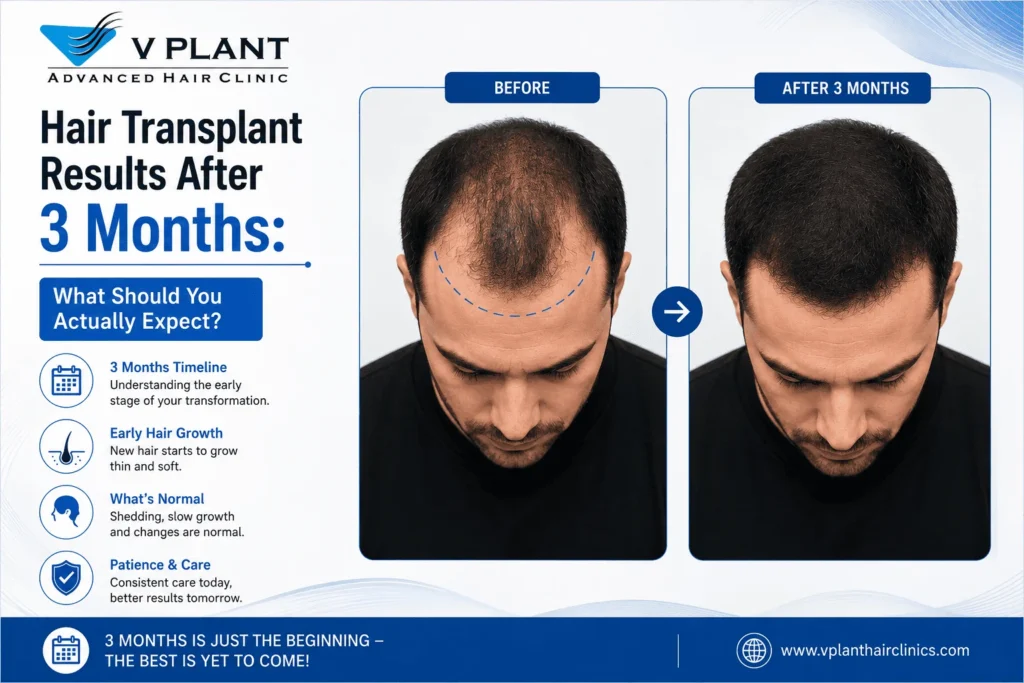
Let me be honest with you — the 3-month mark is where most people start panicking. You’ve had the procedure done, you’ve been careful, you’ve followed the instructions… and your scalp looks almost the same as it did before the surgery. Maybe even worse.
I hear this constantly. And almost every time, the person is perfectly fine. Their transplant worked. They’re just in one of the most confusing phases of the recovery process, and nobody explained it to them properly beforehand.
This guide is going to fix that. Whether you’ve already had your procedure done in India or you’re planning one, I want you to understand exactly what’s happening at each stage — especially at the 2-month and 3-month marks, which is where all the worry tends to pile up.
The Hair Transplant Growth Timeline (What’s Actually Happening Inside Your Scalp)
| Timeframe | What’s Happening | What You’ll See |
| Week 1–2 | Scabs forming, mild swelling around grafts | Redness, light crusting — looks worse than it is |
| 1 Month | Shock loss — transplanted hairs begin shedding | Hair falling out (this is normal and expected) |
| 2 Months | Follicles in resting phase beneath the scalp | Little to no visible change — the quiet phase |
| 3 Months | Early regrowth starts pushing through | Fine, thin hairs beginning to emerge |
| 6 Months | Active growth, strands thickening noticeably | Real density improvement — others will notice |
| 9–12 Months | Full maturation of transplanted hair | Final result — natural appearance, full coverage |
Month 1: Shock Loss — The Part Nobody Warns You About
About three to four weeks after surgery, the transplanted hairs start falling out. This is called shock loss, and it happens because the hair follicles go into a temporary resting state — called the telogen phase — after being moved during the procedure.
Here’s what matters: the hair falling out is not the follicle. The follicle — the living root that was transplanted — is still there, still embedded in your scalp, quietly recovering. What you’re losing is just the hair shaft. Think of it as the plant dying back while the root system gets established underground.
It feels alarming. It almost always isn’t.
2-Month Hair Transplant Results: The Phase That Tests Your Patience
At two months, most patients look in the mirror and feel like nothing happened. The scalp may appear practically identical to before the procedure — or, in some cases, slightly patchier because of the shed hair.
This is the phase that sends people rushing back to their surgeon convinced something went wrong. In the vast majority of cases, everything is completely on track.
Here’s what’s typically happening at the two-month mark:
- The transplanted hairs have shed — this is expected and finished by now for most people
- The scalp surface looks unchanged, sometimes even a little sparse
- A small number of patients start noticing very fine, thin hairs — but most see nothing visible to others yet
- Beneath the surface, follicles are actively preparing for regrowth
The resting phase is real, it’s medically documented, and it ends. The right thing to do at month two is keep following your post-op instructions and wait.
Practical tip: Continue any medications your surgeon prescribed — Minoxidil, Finasteride, or both. Avoid alcohol, smoking, and direct sun exposure on the scalp. These aren’t just suggestions; they genuinely affect how well your grafts survive and grow.
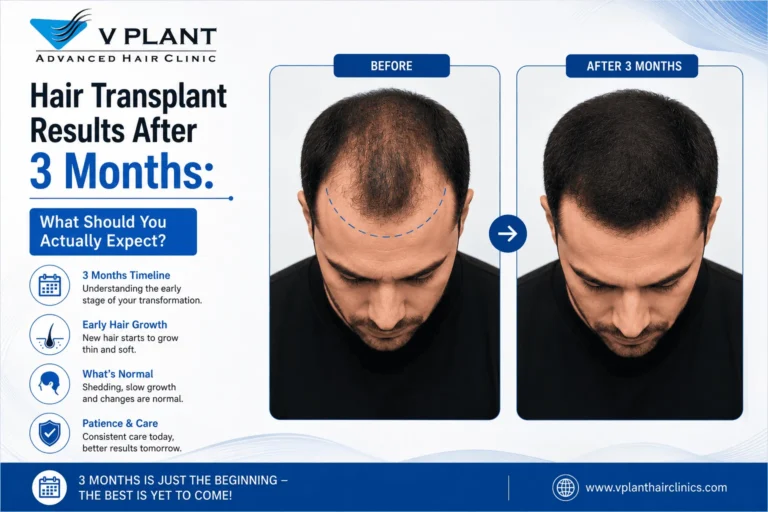
3-Month Hair Transplant Results: Finally, Something to See
Month three is when most people start to breathe again.
The regrowth that begins at this stage is subtle at first — fine, soft, sometimes almost colourless. The strands are thin and the coverage is uneven. But it’s real hair, growing from the transplanted follicles, and it marks the beginning of your actual transformation.
Here’s what to expect at three months:
- New hair is appearing — fine-textured, sometimes slightly wavy or curly initially
- Growth is patchy — some areas fill in before others, and that’s completely normal
- Hairline definition begins — especially visible if you had a frontal transplant
- Density is still low — you won’t look finished, but you’ll see genuine progress
The hair you see at three months is not your final hair. Each strand will thicken, darken, and strengthen over the next several months. What you’re seeing now is the foundation — not the finished result.
Smart habit: Photograph your scalp every four weeks from the same angle and lighting. Day-to-day changes are hard to spot in the mirror, but when you compare photos side by side, the progress becomes obvious. It also helps manage anxiety during the slower phases.
 showing hair transplant results after 3 months with a split before-and-after scalp comparison, hair growth timeline, recovery stages, and expectations for early hair density improvement after FUE hair transplant treatment.](https://vplanthairclinics.com/wp-content/uploads/2026/05/ChatGPT-Image-May-15-2026-01_50_35-PM-1024x683.webp)
Months 6 Through 12: Where the Real Change Happens
Between months six and nine, most patients see the shift they’ve been waiting for. The thin hairs that appeared at month three begin thickening substantially. The scalp fills in. The hairline that looked uncertain starts looking intentional and natural.
By twelve months, the majority of patients are looking at something close to their final result — full density, natural movement, a hairline that suits their face. For some patients, particularly those with coarser or curlier hair textures, the process continues improving up to eighteen months.
FUE, DHI, and MHI: Which Technique Affects Your Results?
One question that comes up a lot — especially for patients in India where all three techniques are available — is whether the method used changes what you see at month two or three. The honest answer: the timeline is roughly the same across all techniques. Shock loss, the resting phase, the slow early regrowth — these happen regardless of how the follicles were implanted.
What the technique does affect is the quality and density of your final result, and how comfortable the recovery is. Here’s how the three main approaches compare:
FUE
Follicular Unit Extraction. The most widely performed technique. Individual follicles are extracted one by one from the donor area and implanted into pre-made channels. Minimal scarring, good for larger sessions. Costs typically ₹40–₹80 per graft at reputable clinics.
DHI
Direct Hair Implantation. Uses a specialised Choi implanter pen — channels are created and hair is implanted in a single step. Greater precision for hairline design, higher density per session. Preferred for frontal work and patients who want to keep existing hair intact.
Advanced
MHI — Modified Hair Implantation
MHI is an advanced evolution of direct implantation, developed specifically to improve graft survival rates and placement accuracy. Rather than the stepwise process used in older methods, MHI uses an implanter device to place follicles directly into the scalp in a single broad movement — faster, more precise, and with less time the grafts spend outside the body.
At VPlant, MHI is combined with complementary treatments including PRP or GFC PRP therapy to improve blood circulation, PDO threads and stem cell therapy to boost collagen production, and Duta shots to inhibit DHT — the hormone most linked to ongoing hair loss. This combination creates better conditions for graft survival and long-term growth.
Who is MHI best suited for?
MHI works particularly well for patients with mild to moderate hair loss who want natural-looking density, anyone who prefers minimal downtime and a scar-free result, and patients with strong donor hair who want to get the most out of each graft. Because of the advanced graft handling and supporting therapies, it’s also the technique of choice for patients who have had previous transplants with disappointing density results.
One practical note on MHI results at three months: because graft survival rates with MHI are reported to be higher than with standard FUE, patients who had MHI may notice slightly more consistent early regrowth across the transplanted area. That said, the timeline is still similar — patience is still required, and month two still looks quiet for most people.
Why India Has Become a Serious Destination for Hair Transplants
India’s rise in the global hair transplant market isn’t just about affordable pricing — though that’s a significant part of it. The country has developed a deep pool of surgical expertise, particularly in cities like Delhi, Mumbai, Hyderabad, and Jaipur, where surgeons operate at volumes that would be unusual anywhere else in the world.
High volume leads to refined technique. A surgeon who performs hundreds of procedures a year develops a level of precision that most Western surgeons simply can’t match at their patient volumes.
On cost: a procedure at a reputable Indian clinic typically costs ₹80,000–₹1,50,000 — the equivalent procedure in the UK or US would run ₹4,00,000–₹8,00,000 or more. The technique and outcomes at quality clinics are comparable. India also offers advanced techniques like MHI that are simply not widely available in Western markets yet.
What Affects Your Results at the 3-Month Mark
Two people can have identical procedures at the same clinic and look noticeably different at month three. That’s not a sign that one transplant failed — it’s a reflection of how many individual factors shape recovery.
Genetics: Hair growth rate is partly inherited. If regrowth tends to run slow in your family, your timeline may be on the longer end — but that doesn’t predict your final density.
Age: Younger patients often see earlier initial regrowth, but surgeons are typically more conservative with hairline design for patients under 35, since hair loss may continue after the procedure.
Graft handling: This is the factor most people underestimate. Graft survival depends heavily on how carefully follicles were extracted, stored, and implanted. Poorly handled grafts don’t grow — full stop. It’s the primary reason to choose your clinic carefully, and one of the core advantages of techniques like MHI that reduce time outside the body.
Post-operative care: The first two weeks are critical. Sleeping position, how you wash your scalp, sun exposure, physical activity — all of it affects graft survival.
Diet and lifestyle: Hair is made of keratin, which is protein. Protein deficiency slows growth. Smoking restricts blood supply to the scalp and is consistently linked to worse outcomes. Alcohol interferes with healing and medication efficacy.
How to Give Your Hair the Best Chance of Growing Well
- Follow your surgeon’s post-op protocol precisely — every instruction has a reason behind it
- Take prescribed medications consistently; Minoxidil and Finasteride (if recommended) make a measurable difference to density outcomes
- Get enough protein — aim for at least 1g per kg of body weight daily during recovery
- Don’t smoke, and limit alcohol — both have documented negative effects on hair transplant outcomes
- Keep the scalp out of direct sunlight for the first three to six months
- Manage stress where you can — elevated cortisol pushes follicles into the resting phase prematurely
Not sure whether FUE, DHI, or MHI is right for your hair loss pattern? Our team offers free, no-obligation consultations.
Book Your Free Online Consultation →
Frequently Asked Questions
Is it normal for the scalp to look worse at 2 months than before the surgery?
Yes — and it’s more common than people realise. The shock loss phase causes the transplanted hairs to shed while the follicles rest. Your scalp may look the same as before the procedure, or even slightly sparser. This is temporary. The follicles are intact and will grow.
What is MHI and how is it different from FUE or DHI?
MHI stands for Modified Hair Implantation. It’s an advanced technique that places follicles directly into the scalp in a single step using an implanter device, reducing handling time and improving graft survival rates compared to standard FUE. At VPlant, MHI is also combined with supporting therapies like PRP, PDO threads, stem cell therapy, and Duta shots to maximise growth outcomes — something standard FUE and DHI don’t include as standard.
Does MHI give faster results than FUE at 3 months?
The growth timeline is broadly similar across all techniques — shock loss, the resting phase, and early regrowth happen at roughly the same intervals. Where MHI can make a difference is in the consistency and density of that early growth, since higher graft survival means more follicles are active from the start.
When will other people actually notice a difference?
Most patients notice early growth themselves around months 3 to 4. The change becomes visible to others — without you pointing it out — around months 6 to 7. By month 9, the improvement is usually significant enough that people comment on it unprompted.
Can the transplant fail even if I do everything right?
A small percentage of grafts — typically 5 to 10% — may not survive even with excellent aftercare. This is factored into graft planning by experienced surgeons. Large-scale failure is almost always the result of surgical handling, infection, or significant physical trauma to the scalp post-op.
How do I know how many grafts I need?
It depends on your degree of hair loss (assessed using the Norwood scale), hair texture, and the density you’re aiming for. A Norwood Grade 3 patient might need 1,500 to 2,000 grafts; a Grade 6 may need 4,000 to 5,000. Your surgeon should calculate a personalised estimate during consultation — be cautious of clinics that quote graft counts before examining you.
Is DHI better than FUE, or just more expensive?
Both produce excellent results in skilled hands. DHI allows for higher implantation density and more precise hairline control. FUE is generally preferred for larger graft sessions. The right choice depends on your specific case — and if you want the most advanced option currently available, MHI takes that further still.
Does a hair transplant work for all types of hair loss?
Hair transplants work best for stable, pattern-related hair loss with adequate donor area density. They’re not well-suited for diffuse thinning across the entire scalp, or for conditions like alopecia areata that aren’t under control. A thorough consultation will determine whether you’re a good candidate — and if not, a good surgeon will tell you that honestly.
About VPlant Hair Clinics
At VPlant, we perform FUE, DHI, and MHI procedures — including MHI Luxe, our premium package that combines the MHI technique with luxury accommodation, airport transfers, and a full six-month post-operative medicine kit. Our surgical team has handled over 20,000 cases across a wide range of hair loss patterns, and our focus is consistently on hairline design that suits your face — proportionate, natural-looking, and built to age well with you.
We offer detailed pre-procedure consultations where we walk you through your options, set honest expectations about the timeline, and give you a personalised graft estimate. No vague promises, no upselling techniques you don’t need.
Learn more about MHI at VPlant →
Ready to find out which technique is right for you?
Book Your Free Online Consultation →
The Honest Summary
A hair transplant is one of the few genuinely permanent solutions to hair loss — but the results come slowly, and the middle months are harder than most people expect.
- 2 months: Minimal or no visible growth. The follicles are resting. Don’t panic.
- 3 months: Early regrowth begins — fine and thin, but real.
- 6 months: Density improves noticeably. Others start to see it.
- 12 months: Final result. Permanent, natural-looking growth.
If you’re at month two staring at your scalp and wondering whether it worked — it almost certainly did. The follicles are there. The growth is coming. Give it the time it needs.
Have questions about FUE, DHI, MHI, or your specific hair loss pattern? Book a free consultation with our team.