




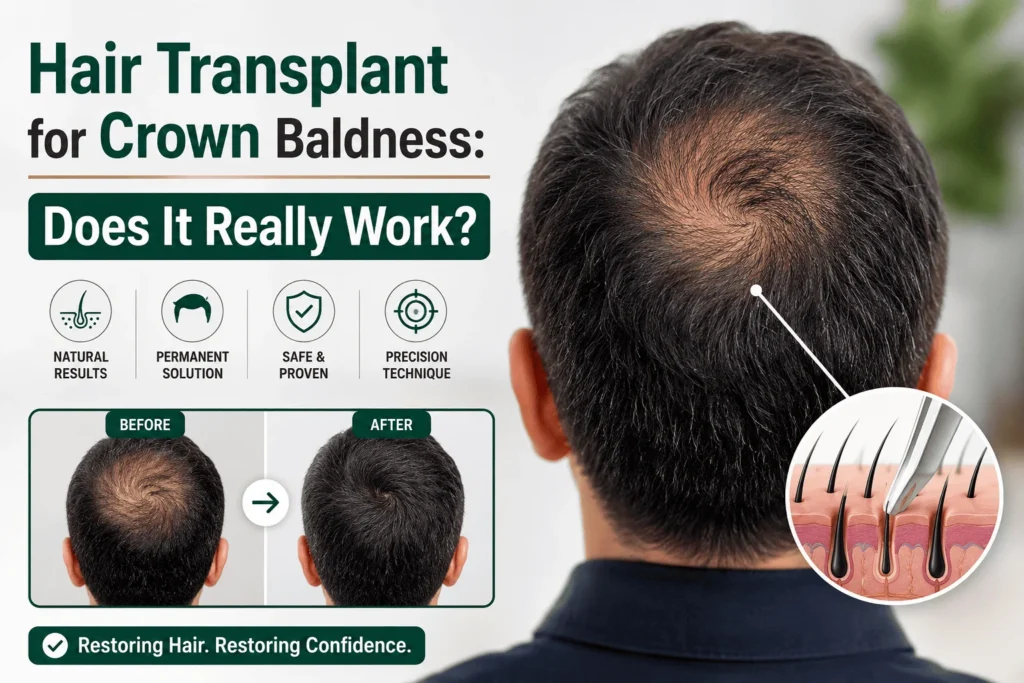
I get asked this question at least once every single day, usually by someone who’s been quietly obsessing over a bald patch on the crown of their head for months — maybe years. And I completely understand why it keeps coming up, because the crown is one of those areas where most of the information out there is either too vague, too optimistic, or buried under stock photos of perfect results.
So I’m going to give you the actual answer. Not a brochure version. The kind of answer I’d give a friend who sat down in front of me and asked.
First — Why Is the Crown So Difficult to Begin With?
Most people assume hair transplants are hair transplants, regardless of where on the scalp you’re working. That’s not quite right.
The crown is genuinely one of the harder areas to treat, and the reason comes down to a few things that are specific to that part of the scalp.
To start with, hair at the crown doesn’t grow in a uniform direction. If you look closely, it radiates outward from a central swirl point — called the whorl. Implanting grafts in the wrong direction even by a few degrees makes the result look off. Not obviously wrong, but something about it just doesn’t sit right. Experienced surgeons who’ve done a lot of crown work know this intuitively. Less experienced ones sometimes learn it the hard way at a patient’s expense.
Then there’s the progressive nature of crown baldness. The hairline tends to stabilise at some point. The crown often doesn’t. It keeps expanding — slowly, but it does. Which means if you transplant hair into the crown today without thinking about what it might look like five or ten years from now, you can end up with a transplanted ring surrounded by new baldness, and that looks worse than just having a bald crown in the first place.
And finally — the crown is often bigger than people think. What looks like a modest patch in a photo taken from above is usually 60 to 80 square centimetres of scalp when you actually map it out. That requires a lot of grafts.
None of this means a crown transplant is a bad idea. It just means it requires more planning and more honesty than a straightforward hairline job.
So — Does It Work?
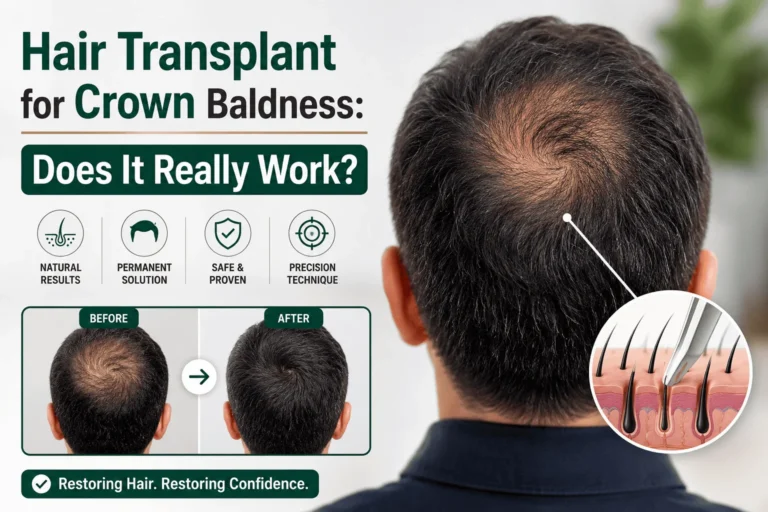
Yes. Done well, a crown hair transplant works really well.
I’ve been doing this for a long time, and some of the most satisfying results I’ve seen — the patients who come back months later practically in tears at how natural it looks — have been crown cases. There’s something about the crown specifically, maybe because it’s the area people have been staring at and feeling self-conscious about for years. When it comes back, the change in how someone carries themselves is genuinely visible.
“The crown is where I see the most emotional impact in my patients. Hairlines matter, but something about restoring the crown hits differently — it’s the area people had completely given up on.”
— Dr. Amit Agarkar, VPlant Hair Clinics Mumbai
The success rate for crown transplants, in terms of grafts that survive and grow, is 85 to 95 percent when the procedure is done by someone who knows what they’re doing. That’s a genuinely high number.
But — and this is important — the result you see at eighteen months depends on more than just whether the grafts survived. It depends on whether the direction was right, whether the density was planned correctly for your specific hair type, and whether you have a plan for protecting your remaining natural hair. A transplant that ignores that last part can look great at first and gradually look less natural as the surrounding hair thins out.
Quick reality check on density:
A crown transplant won’t give you the hair density of a 22-year-old. What it gives you is coverage — enough hair in the right places to make the area look natural and full from all normal viewing angles. That’s a very achievable goal.
Which Technique Is Actually Best for the Crown?
You’ll see FUE, DHI, and MHI mentioned a lot when you research hair transplants, and each one has genuine strengths. Here’s my honest take on each of them specifically for the crown:
FUE — Follicular Unit Extraction
This is the most widely used technique in the world and it works well for the crown. Individual follicles are extracted from the donor area at the back of your scalp and transplanted one by one. The recovery is relatively comfortable, the scarring in the donor area is minimal, and most patients are back to their normal routine within a week.
For most crown cases, FUE is a perfectly solid choice — especially in the hands of an experienced surgeon who understands the whorl pattern.
DHI — Direct Hair Implantation
DHI uses a specialised implanter pen, which lets the surgeon place each follicle directly into the scalp without making incisions first. The advantage in the crown specifically is that you can get slightly higher density, and you can work between existing hairs without damaging them. If you still have some native hair left in the crown area that you want to preserve, DHI is worth considering.
MHI —Modified Hair Implantation (VPlant’s technique)
This is what we use at VPlant for most of our crown cases. MHI builds on the precision of DHI but places a particular emphasis on minimising trauma to the scalp tissue — which matters more in the crown than it does at the hairline, partly because of the blood supply differences in that area. We find healing is a little faster and the natural direction of the whorl is easier to replicate with precision.
| FUE | DHI | MHI (VPlant) | |
| Works best for | Most crown patients | Existing hair preservation | Complex whorl, precision |
| Density Possible | Good | Very good | High with natural direction |
| Recovery | 5-7 days | 5-7 days | Slightly faster |
| Scarring | Tiny dots , donor area | Tiny dots, donor area | Minimal trauma |
Honestly though — I’ve seen outstanding crown results with all three techniques. The technique matters, but the experience of the surgeon matters more. A skilled surgeon with FUE will produce a more natural result than an average surgeon with any other method.
How Many Grafts Are We Talking?
More than most people expect, usually. The crown looks deceptively manageable until you actually map out the surface area.
Here’s a rough breakdown based on what we see in practice:
| Bald Patch Size | Grafts Needed (roughly) | Realistic Outcome |
| Small — about 4 to 6 cm | 1,500 to 2,000 | Good natural coverage, solid density |
| Medium — about 7 to 10 cm | 2,000 to 3,000 | Noticeable improvement, realistic density |
| Large — over 10 cm | 3,000 to 4,500+ | May need two sessions for the best result |
These numbers assume a single session. Patients with very large crown patches sometimes need two sessions spaced about a year apart — not because anything went wrong, but because there’s a limit to how many grafts can be safely harvested in one sitting, and the crown can simply demand more than that limit.
Hair texture also plays into this. Coarser, slightly wavy hair gives better visual coverage per graft than fine straight hair. So two people with the same number of grafts can end up looking quite different depending on their natural hair characteristics.
| Stage | Crown Situation | What This Usually Means for You |
| NW1 to NW2 | Early thinning | Good time to start — a small session plus medical treatment can get ahead of the loss |
| NW3 to NW4 | Clear bald patch | Classic crown candidate — one session usually gives excellent results |
| NW5 | Large patch, merging with hairline | Needs staged planning — we’ll talk honestly about priorities and timelines |
| NW6 to NW7 | Very extensive loss | Donor supply becomes the limiting factor — realistic expectations conversation is essential |
The Norwood Scale — What Stage Are You At?
For anyone at NW6 or NW7, we don’t just turn you away. But we have a very frank conversation about what donor hair you have, what we can realistically achieve, and how to prioritise it. Sometimes that means addressing the crown partially, sometimes it means focusing resources on the hairline instead. It depends entirely on the individual.
What the Recovery Actually Looks Like
I want to give you an honest picture here because a lot of people go into this expecting a smooth, linear journey and get caught off guard.
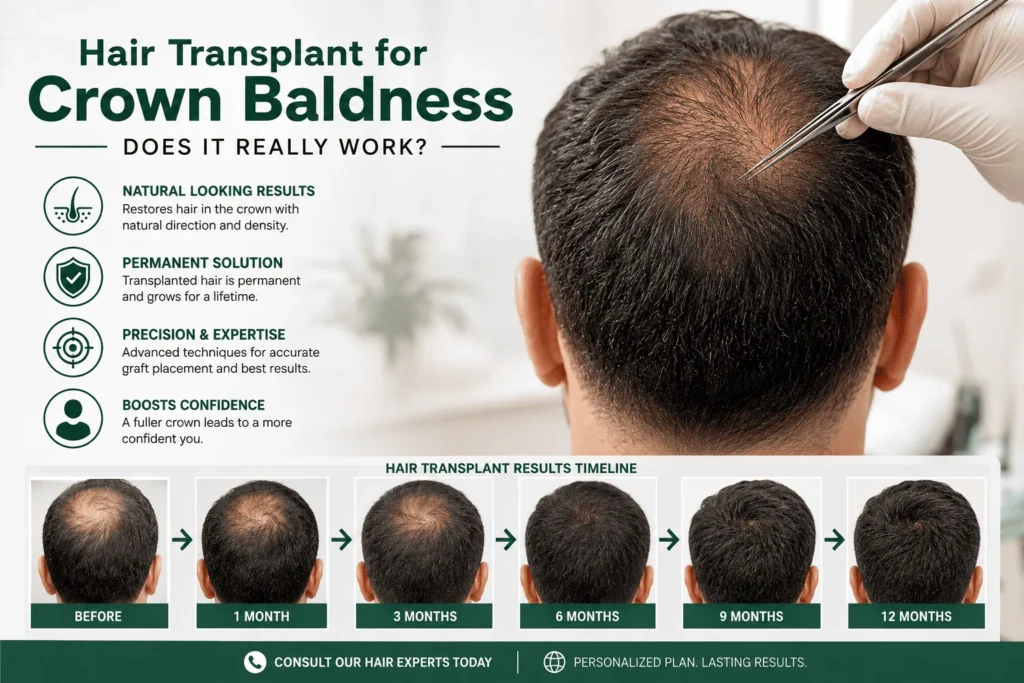
The first week or two
The transplanted area will be red, there’ll be tiny scabs around each graft, and honestly you won’t want to be seen on a video call for a few days. That’s just reality. The redness fades faster than most people expect — usually within ten days to two weeks. You can be back at a desk job within five to seven days for most people.
Weeks two to six — the part nobody warns you about
The transplanted hairs fall out. I want to say that again clearly because every single patient who doesn’t know about this thinks their transplant has failed the moment it happens: the hairs fall out. This is completely normal. It’s called shock loss and it’s part of the cycle. The follicles are alive and resting underground — they’ll start growing again. But watching newly transplanted hair disappear into the drain is unsettling, and I’d rather you know it’s coming.
Months three to four
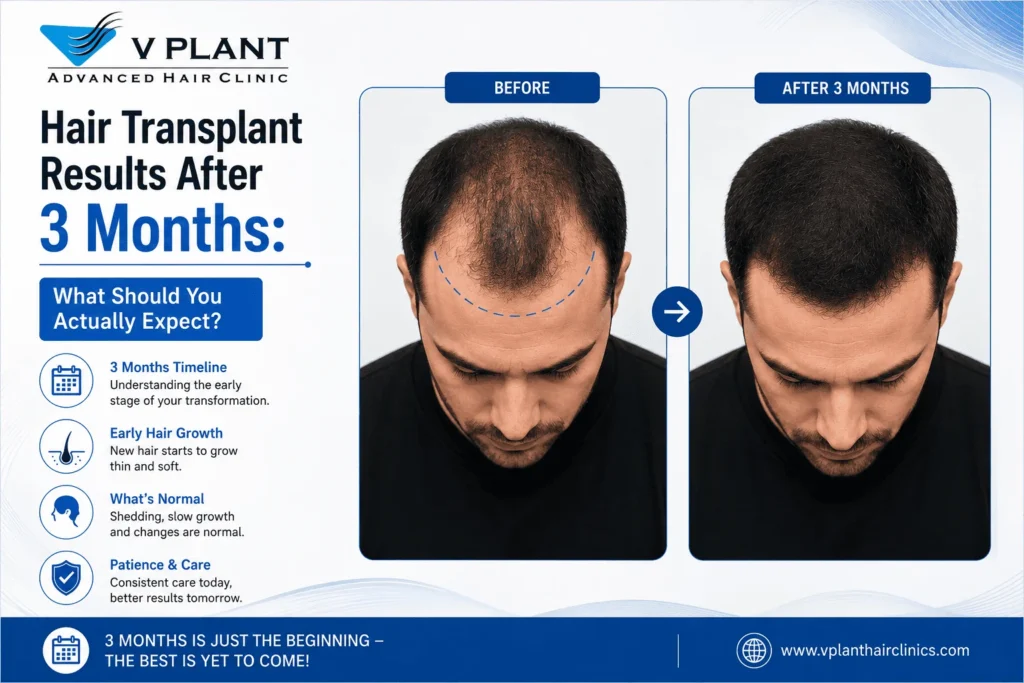
New growth starts. It’ll look thin and a bit patchy at first — almost like peach fuzz. Don’t judge the result here. I’ve had patients message me in a panic at month four convinced something went wrong, and six months later they’re sending thank-you messages. The three to four month stage is not the result.
Months six to eight
Now it starts to look like something. The hairs are thickening, the density is building, and you can actually see the shape of what you’re going to end up with. Most patients feel genuinely positive at this point.
Months twelve to eighteen — this is the actual result
Full growth, mature hair, proper density, natural direction. Crown results tend to take a bit longer to fully mature than hairline results — usually a couple of months longer — because of the slightly different blood supply to the vertex area. Eighteen months is the number I give people when they want to know when they can judge it properly.
The Things That Can Actually Go Wrong
How we handle ongoing hair loss at VPlant:
We don’t just do the transplant and wave goodbye. Most of our crown patients leave with a maintenance plan — whether that’s GFC PRP, Exosome therapy, Biotin PRP, or medical options like minoxidil. Protecting the hair you have is just as important as restoring what you’ve lost.
What Does It Cost in India?
India offers a very significant cost advantage for hair transplants compared to the UK, US, Australia, or the UAE. That’s not because the quality is lower — it’s because the cost of running a clinic here is fundamentally different. The same procedure, same technique, same level of care, at a fraction of the price.
| Grafts Required | VPlant Mumbai (approx.) | Equivalent UK / US cost |
| 1500 to 2000 | Rs. 40,000-Rs. 70,000 | £3,500 – £5,000+ |
| 2000 to 3000 | Rs. 65,000 – Rs. 1,00,000 | £5,000 – £8,000+ |
| 3000 to 4500+ | Rs. 1,00,000 – Rs. 1,50,000+ | £8,000 – £15,000+ |
These are ballpark figures — your actual cost depends on how many grafts you specifically need (which we can only assess properly by looking at your scalp), the technique we use, and what’s included in your package. We don’t give quotes without assessments because a number without context isn’t actually useful to you.
One thing I feel strongly about:
Please don’t let price be the main factor in your decision. I’ve personally met people who spent less than they planned on a hair transplant and ended up spending twice as much trying to fix it. The crown is an area where cutting corners has very visible consequences.
The Questions I Get Asked Most
Is the result actually permanent?
The transplanted hair, yes — completely. Those follicles came from the back of your scalp, which is genetically programmed not to respond to DHT the way your crown hair did. Once they’re in, they stay. What isn’t guaranteed is your surrounding native hair, which is why I always recommend pairing a transplant with some form of ongoing hair loss management.
When will I actually see results?
Realistically — and I stress realistically because I’d rather you know than be disappointed — the full result takes twelve to eighteen months. You’ll see new growth starting around month three or four. It starts looking genuinely good around month six to eight. The crown specifically tends to take a couple of months longer than the hairline because the blood supply to the vertex is slightly less abundant. Patience is genuinely part of this process.
Can I do my hairline and crown in the same session?
Sometimes yes, sometimes no. It completely depends on how many grafts your donor area can safely provide in one session, and what your priorities are. If donor supply is limited, I’ll usually recommend prioritising the hairline — because it has more day-to-day visual impact than the crown. We’ll work this out together at your consultation.
What if I don’t want surgery right now?
That’s a completely valid position and there are good options. GFC PRP, Exosome therapy, and Biotin PRP can produce meaningful results for early thinning — they won’t regrow a fully bald crown, but they can slow or partially reverse early loss and significantly delay the point at which surgery makes sense. We’ll tell you honestly whether surgery is actually necessary for your situation yet or whether it’s worth trying non-surgical options first.
Can women have a crown transplant?
Yes, women can absolutely be good candidates — female pattern hair loss very commonly shows up as thinning at the crown and top of the scalp. The evaluation is a little more involved because we need to rule out hormonal causes, thyroid issues, and nutritional factors before recommending surgery. But if you’ve done that groundwork and the cause is androgenetic, transplant is absolutely on the table. We have a specific process for evaluating women at VPlant.
What’s the difference between FUE, DHI, and MHI again — in plain terms?
FUE takes follicles out one by one and places them into pre-made tiny cuts in the crown. DHI does the same but uses a specialised pen to implant directly without pre-made cuts, which allows slightly higher density and is gentler on existing hair. MHI is our refined version of that approach at VPlant, specifically optimised for minimising trauma and matching the crown’s natural direction. All three produce good results in the right hands.
My Honest Bottom Line
My Honest Bottom Line
Crown hair transplants work. They genuinely do. But they work best when the surgeon is honest with you, when the planning is done properly, and when you go in with realistic expectations rather than the best-case scenario from someone’s Instagram page.
The crown is more demanding than the hairline. It needs more grafts, a more experienced hand, and a longer timeline. It also needs a plan for what happens to your hair in the years after surgery, not just in the months immediately following it.
If you get all of that right, the results are remarkable. I’ve watched patients who’d been hiding under hats for years start leaving the house without a second thought. That doesn’t get old, no matter how many times you see it.
If you’re serious about exploring this, the most useful thing you can do right now is book a proper assessment — not a phone call, but an actual in-person evaluation where we can look at your scalp, map your donor area, and give you real numbers rather than estimates pulled from a table on the internet. That’s free at VPlant, and there’s no pressure to commit to anything at the end of it.
Book your free consultation:
Call 98115 16411 or visit vplanthairclinics.com
Dr. Amit Agarkar · VPlant Hair Clinics, Mumbai
Related Reading
FUE Hair Transplant · DHI Hair Transplant · MHI Hair Transplant · FUT vs FUE vs DHI vs MHI · Hair Transplant Cost India · GFC PRP Treatment · Exosome Therapy · Bio PRP · Biotin PRP · Stem Cell Hair Treatment · Scalp Micropigmentation · Hair Loss in Men · Hair Loss in Women · Before & After Gallery · Hair Graft Calculator · Norwood Scale · DHT and Hair Loss · Androgenetic Alopecia · Vertex Baldness · Crown Hair Loss Treatment Mumbai · Hair Transplant Crown Success Rate · Crown Baldness Surgery India · Permanent Hair Transplant Crown